This article is probably going to be a lot longer than the rest of the posts, but I think that sharing my thoughts on the current landscape is important.
Saturation Curves (not the audio kind)
One of my bigger business-related regrets is not starting Lese sooner than I did; I was developing the first initial lineup of plugins (mainly Sweep but also the first 5 others) from 2018, and only managed to actually put things out in late 2021.
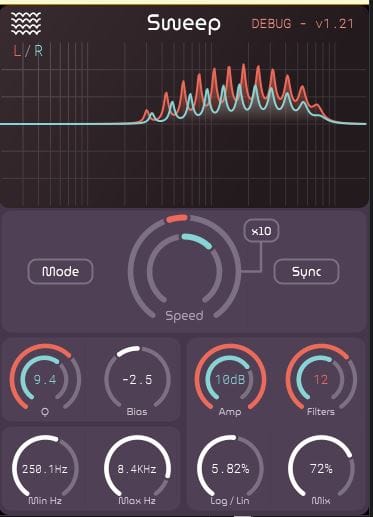
Sweep in particular went through about 6 different iterations before becoming what it is today, like this one;
I think this primarily because of the notion of the “curve of saturation” that has occurred in recent years in the music tech industry, as well as in other businesses where indie development is more feasible. The biggest example of this would be the amount of games that are now being listed on Steam.
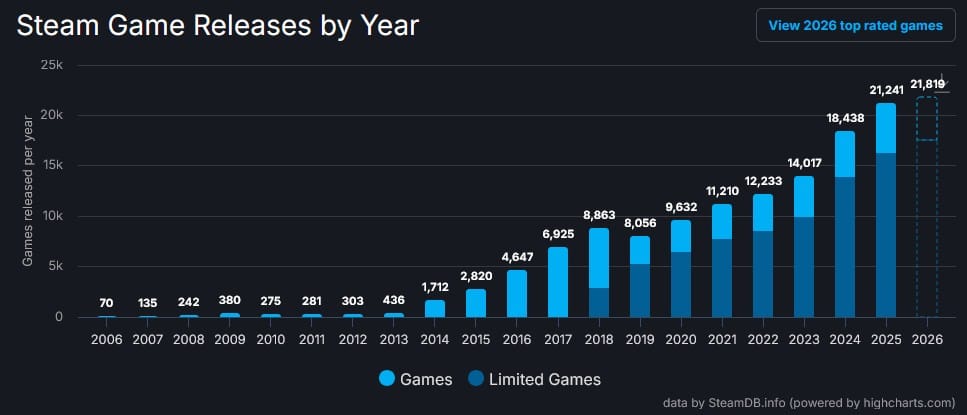
Basically, the amount of noise that you have to co-exist with in any tech space has been steadily rising, and will only continue to rise from here. Putting something out a few years earlier compared to when I actually did would have been beneficial because of this. Calling it competition is disingenuous, because a lot of what is coming out now is incredibly low effort, and produced purely to make a quick buck. On the topic of Steam & video games in general, this has already been noted.
Of course, everyone who has been paying attention is already aware of this (and not just in the audio world, obviously), but I’m just trying to convey some of my thoughts on what the landscape will look like a few years, or even a few months from now.
The New Landscape
New Companies
About once a week now I have some “new plugin company” contacting me asking for a shout-out / collaboration of some sort. I’ll look at their social media pages / website and they started a month ago and somehow have developed 20 plugins in that time (or alternatively, have just made 1 or 2 that have some weird gimmick). Almost all of them are incredibly basic and all of their marketing material is also very obviously AI generated.
I don’t really want to go into specifics of which companies are doing this; they come so frequently now you’ve probably seen a handful of your own that can serve as examples. Publications like Synth Anatomy and Music Tech noted this trend a few weeks ago, but it’s probably been the case for at least the last six months.
Cloning
Another aspect of the new landscape is that AI tools have made it absurdly easy for people to immediately clone mechanics of things that they see online. Once again, this mainly is occurring with video games, but is also happening with audio tools.
Beyond purely software, some people have even managed to have AI models get hex data dumps of firmware loaded in things like guitar pedals, and reverse engineered the audio processors that were inside of the firmware to be used elsewhere. Most western models will likely implement safeguards to prevent people from straight-up copying other people’s stuff pretty soon, but this is something that open source models will definitely not be doing.
New Scams
A few months ago I started getting some support emails asking about the “Full Bundle” sale on random reseller websites. It’s always a reseller I have never heard of, and they advertise my plugins with images like this (I’ve covered up some of their “logos” as there’s no need to advertise for them):
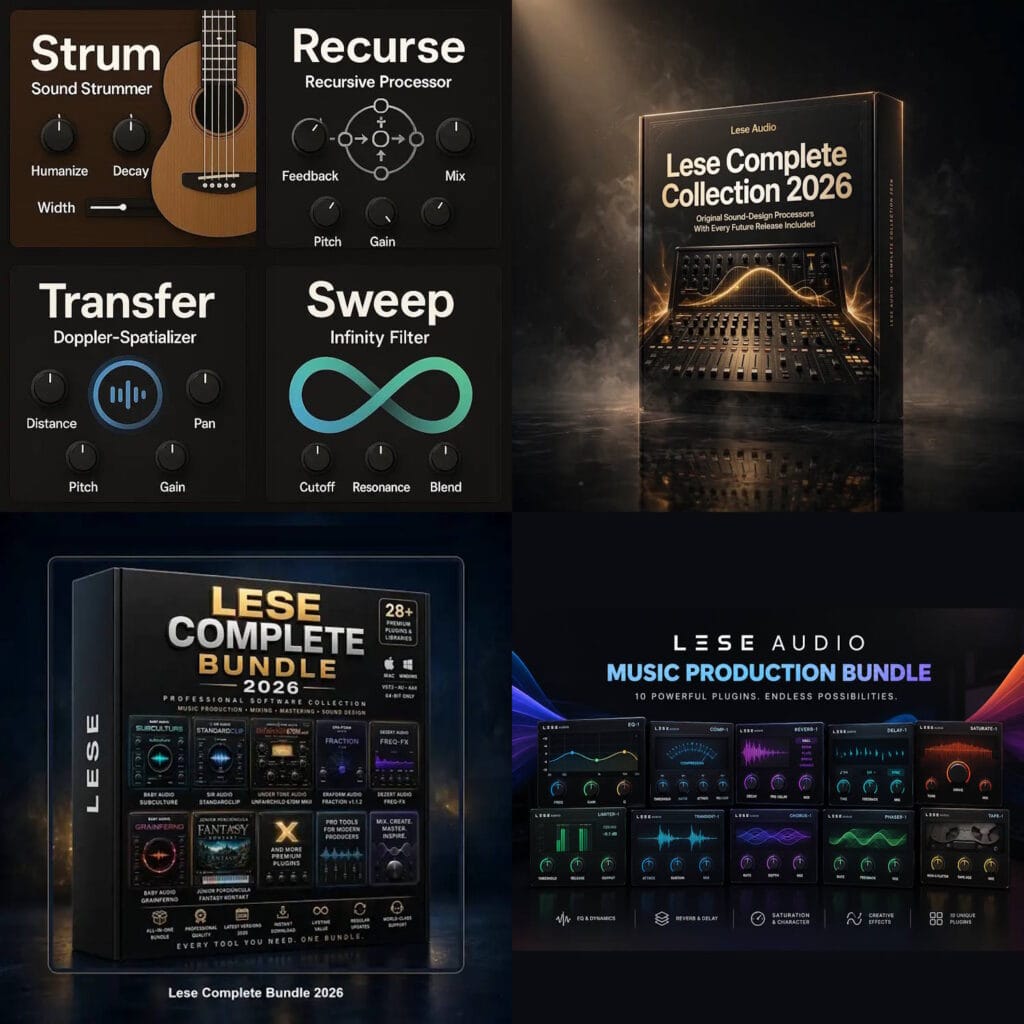
Now that anybody can spin up a (somewhat) legitimate looking website, the skill requirement for bad actors doing things like this has also risen to zero, and we get stuff like this.
I have no idea what they’re actually selling, probably just nothing, or poorly cracked / broken copies of the plugins. It probably doesn’t cost a lot to host websites like this, so even getting a few “customers” would be enough for them to continue running.
This in particular is what made me want to write this article, as this is the most egregious example of the new landscape; non-technical music producers making little tools that they’d like to have for themselves is mostly fine, but there’s really no reason for something like this to exist.
Where to go from here
The word for the new-wave of AI-generated everything is “slop”, which I personally don’t like to use as I think it’s reductive. I think that using AI tools responsibly as an enhancement for existing work is fine, honestly (aside from doing things like image / video generation, as those universally look terrible).
Full disclosure, I do use some AI tools for Lese, but it’s nothing that you would see (mostly just for working with advertising APIs, business-side data analysis, and fixing internal issues with the site), and I think that’s fine. Any programmer in the current year who tells you that they aren’t using AI is lying to you, btw.
Product Value Shifts
For most of those “new companies” I mentioned earlier, I’ve kept tabs on them. They stop bothering with whatever they were trying to do and abandon the projects after only a month or two (sometimes only a few weeks).
When making a program only takes a few hours of your time (instead of a few months) the perceived value of the product that you’ve been working on goes down by multiple orders of magnitude. Lese made very little money during the first year or two of operation, and I don’t think that most of these new players would be able to stomach something like that, unless they were getting some outside investment (and good luck with getting that).
In my opinion, the value of software is not in it’s ease of use, or it’s features, but in it’s support. None of these short-term products are going to have any sort of long-term support unless the end user goes ahead and reverse-engineers it (in some cases, a reverse engineering of a reverse engineering). If you don’t even value it, Why would someone want to bother with paying attention to whatever you were doing, let alone give you money for it?
Bifurcation
On the topic of value shifts, I also think that we’re seeing some market bifurcation already happening. There’s traditionally been some big distinctions between the “pro” market of audio stuff vs. the “consumer” market, but we’re going to see a branching off of the consumer market to another aspect where some software / tools turn into “content” that have the intention of just grabbing attention short-term and getting clicks (like the various kinds of “meme plugins” that exist now). Anyone who makes tools that are serious and high-effort probably don’t have to worry about that sort of stuff taking away from what they’re trying to do.
Some might argue that it’s an elitist take, but almost everyone who got into doing DSP / plugin development prior to AI were doing it to have an actual impact on the music industry, rather than making disposable stuff for quick bursts of attention.
The cost of Tokens
The other aspect of AI adoption is that the cost of these tokens is massively subsidized by the companies themselves, similarly to how tech companies of the 2010s operated (like Uber); Give people something cheap until they’re dependent on it, and when they are dependent, jack up the price. The era that occurs after the price hikes is where these companies actually start to make money.
In the case of AI tools however, the “jacking up” of the price is going to be a much more difficult change to swallow, some predictions are that the cost will increase by about 1000%, and the cost will differ based on model & provider (and full disclosure, this is absolutely going to happen eventually).
Larger organizations might be able to foot this bill, but the people who are making things to try to get money quickly will probably think twice before spending larger amounts on tokens. This will likely lead to a tapering off of the amount of stuff that gets copied / made via vibe-coding a few years from now. It’s never going to go away completely; Local models are available and anyone with the hardware to run them can do so, but the floor to entry will not be quite as low as it is now.
Backlash
I’ve talked about this issue with a few different “outsiders” (that is, people who aren’t working in the wider ‘technology’ industry) and it’s an interesting observation. AI for most people is just something that they can generate stupid images they think are funny, or use as a sounding board for ideas (and if they’re lucky, maybe it’s a thing they were invested into). The uses that we’re seeing in the new landscape are totally different and have a much wider impact than what the average person is being exposed to, and even those people who aren’t (yet) having their livelihoods threatened and communities diluted by this phenomenon are already growing fatigued.
I do think that some wider backlash against the proliferation of this stuff is coming, but I don’t think that the backlash is going to be from any particular cultural aspect, it’s probably just going to come from the years-long economic downturn that comes at the end of it.
Last Thoughts
I am not that old; the internet that I grew up on was the internet of the early 2010s. People from older eras from that would regard that era of the internet the same way that I regard the internet now, but objectively this is the worst state it’s been in. Many sites that I used to go on either no longer exist, have effectively no traffic, or have been filled with spam.
It’s bad, but given points that I’ve brought up before, I think that this year + next year will be seen as the worst of it before tapering down. At the end of the day, a lot of the AI evangelists are just “current thing” peddlers, many of the larger influencers who do this were the same people really into NFTs during the pandemic, and we all know how much time they spend talking about them now.
The Future of Lese
In trying to find ways to stand out, I spent a substantial amount of money this year + last year making prototypes for different hardware systems (eurorack modules, desktop synths, absurdly complicated experimental instruments) and I’ve settled on some stuff that will be practical for me to build & distribute with the limited space+resources that I have. Maybe if they are successful the future can bring even more complex projects.
Ultimately I still have lots of ideas, and will keep working at bringing them to you all, but in a way that is respectful of both the craft and to the wider community. I hope that other developers, and especially aspiring developers can do the same.
I wrote this article to hopefully spark a conversation about this new landscape, so if you’d like to give feedback / share your experiences, feel free to send an email to hello@lese.io, or leave a comment below. This landscape shifts quickly, so I’ll probably write another article regarding it in the future.