

More updates are here
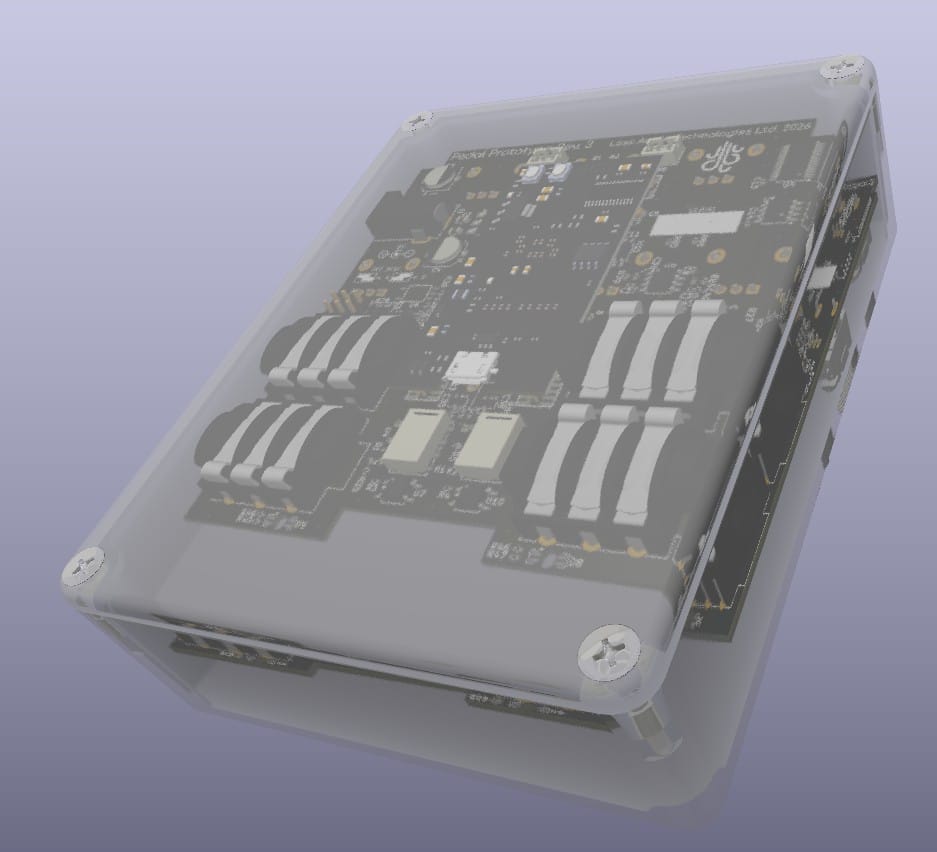
We’ve been working hard on some things lately, a few plugin concepts here and there, along with something we’ll hopefully have a lot more details for you about soon (this is just a mockup render, but we already have a few prototypes out there):
In the meantime, we’ve been adding some more improvements to the plugin lineup as well;
Smear 1.3.0
We’ve added two more processors to Smear;
Bloom is a magnitude-based spectral reverb. Instead of feedbacking whole spectral frames like Blur, each individual bin holds onto incoming energy and lets it decay away over time, smearing sustained sound into a lingering tail. The Size parameter sets how long that tail lasts, and Damping shortens the tail at higher frequencies, similar to how a real room behaves.
There’s also the Prism processor, which spreads the individual frequency bins of the sound out across the stereo field. Depending on the Pattern parameter, bins can be fanned out from low to high frequencies like light through a prism (“Spectrum”), scattered to fixed, random positions (“Random”), or split into a wide comb by hard-panning alternating bins left and right (“Alternate”).
Impulse 1.3
We’ve also updated Impulse to 1.3 as well, fixing a bunch of issues you all have been reporting, as well as adding a bunch of quality of life / UX improvements.
Additionally, Impulse now has directionality support, allowing you to create different kinds of emission patterns for the sources for directional-informed acoustic simulation.
With Impulse 1.3, we’re also announcing another collaboration!

Living Sky by MNTRA is a brand-new convolution reverb plugin, designed for professionals working in surround sound and ambisonics. It processes audio in real time on your graphics card to allow for hundreds of internal channels to be handled at once.
Along with MNTRA’s factory IRs, we’ve bundled a small selection of experimental spaces to be used with Living Sky. We made a little webpage that goes over it here. The IRs were generated using Impulse, at a few different ambisonic orders.
We currently have a promotion on for our fall sale; you can use the code LFALL26 to get 25% off anything in our store. Happy Producing!
One Response