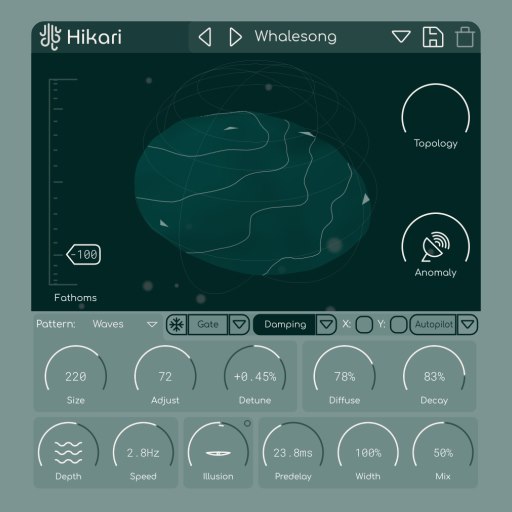
Hikari is an ocean-themed random reverb.
Emulating uncommon digital reverbs from the 1990s and early 2000s, Hikari aims to create something unconventional.
Adding in Hikari’s navigation & anomaly system, where moving to different positions makes the reverb behave differently according to the topology of the ground below, Hikari is made for sound exploration.
Highlights

Navigate the Ocean Floor
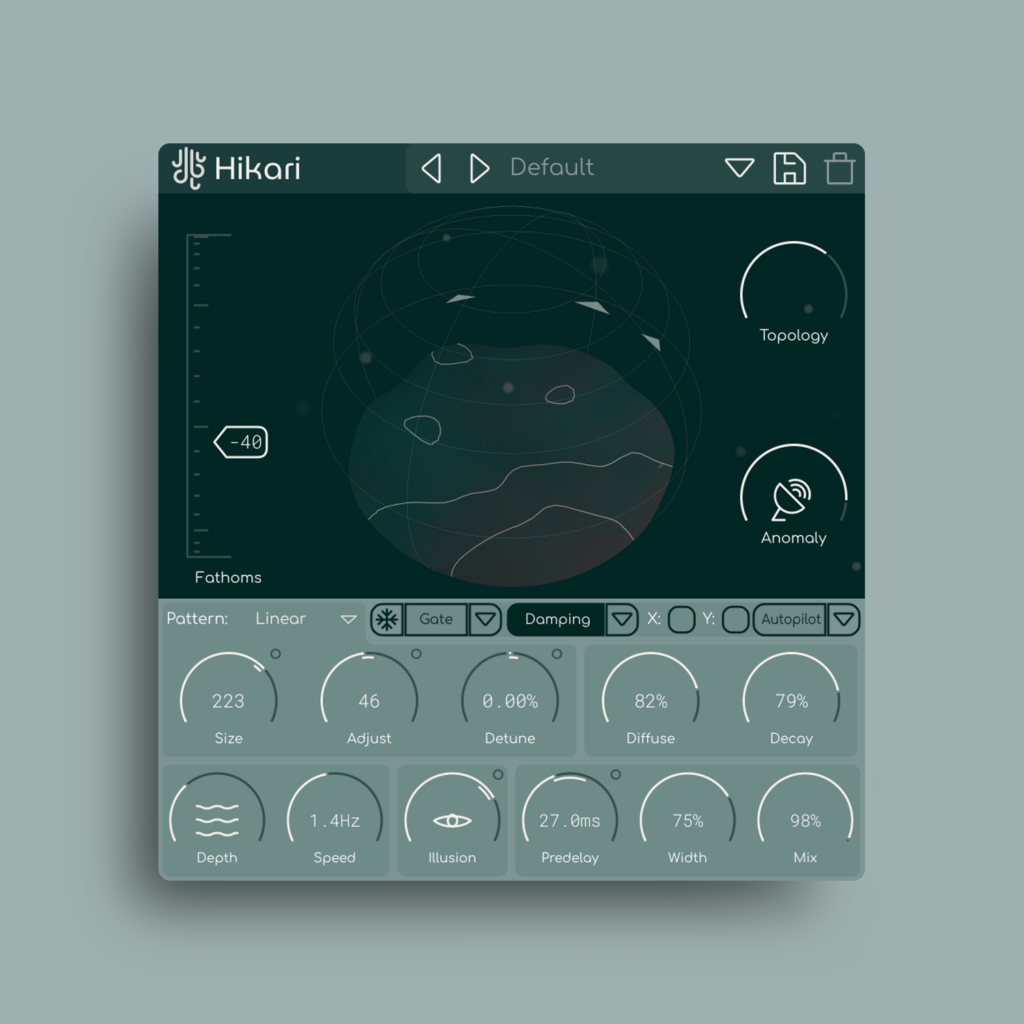
Central in Hikari’s interface is the “navigator”, which lets you move around in two dimensional space. The contours of the terrain beneath the navigator are sampled and used to subtly alter various settings in the reverb algorithms. The two dimensions of the current navigation position can be used to modulate various parameters, using the same workflow that is available plugins like Glow and Smear.
The navigator can also enter “autopilot” mode, where the movement is automated & adjusted by various controls.
Picking up an Anomaly…
The navigator also points to multiple positions of interest, called anomalies. When you get close to the anomaly positions, the sound will change. Anomalies are randomly generated in-between plugin states, so the positions of them, and what they do is largely random.
There are additional audio processes that only occur during anomaly states.
Illusion & Fathoms
Along with a reverberator, Hikari also features multiple additional processors to add ambience & create texture on top of what is already being processed.
Illusion is a short, granularized reverse-audio effect that reads from an audio buffer. It essentially makes your sound come back again, but very disjointed.
The fathoms control adjusts the “depth” of the signal (thats why it’s measured in fathoms!). It does multistage filtering, subtle decorrelation, and light noise adjustments.
Reviews
sound_sculptor Australia 2026-07-11
Priya United Kingdom 2026-06-06
Rachel Ndiaye France 2026-04-24
Priya Sharma United States 2026-04-22
Hikari's special, fully resizable interface ensures this, featuring a navigator for moving in a two-dimensional space similar to a map filled with reverb algorithms.
Synth Anatomy 2025-07-21
The contours of the terrain beneath the navigator are sampled and used to subtly alter various settings in the reverb algorithms.
Synthtopia 2025-07-21
Overview
Don’t want to read the manual? Check out this video for a look into all of Hikari’s features:
Hear it in Action
This video goes over Hikari’s various presets; using varied sound sources in all of them, demonstrating Hikari’s flexibility.
Copy Protection
No dongles
We don’t use any hardware dongle systems for activation, and no activation juggling is nescessary with our plugins.
Licenses are valid on up to 6 computers at once, and you can also do offline activation.
Buy it once, use it forever
We feel that any good tool should try to do it’s best to get out of your way, that’s why our plugins are not subscription based.
No need to worry about license validity here.
No tracking
Our plugins don’t collect any of your personal information.
The only times that they connect to the internet is for activation purposes, and to check for updates and news items (and you can turn these features off).
Updates
Blog posts related to Hikari
Teuri 1.1, Smear 1.2 + Modulation Improvements
New updates are here! Teuri has been updated to 1.1.0: We added the ability to do key-tracking on the resonator (replacing the center frequency control...
Read MoreNow Available: Hikari, A Generative Reverberator Audio Plugin
Greetings We just put out a new plugin, Hikari. Hikari is based off of a number of weird digital reverberators from the 1990s and 2000s...
Read More- Anomaly system, allowing for unpredictable processing in special states
- Feedback Delay network modelling reverberation
- Input tone controller (filtering, de-correlation, noise processing)
- High-quality diffusion network & damping system
- Super cool visualizer / controller system
- Vectorized, resizable interface
Windows: Supports VST3 & AAX
MacOS: Supports VST3, AU & AAX (Intel and ARM)
The full manual is available on the Lese documentation website
Also Check Out...
(may only be loosely related, based on how many similar tags they have to Hikari)